Research Article | | Peer-Reviewed

Evaluation of Nitrogen-fixing Inoculants for Enhanced Production of Groundnut (Arachis hypogea L.) in Pawe District, North Western Ethiopia

Received: 12 March 2025     Accepted: 31 March 2025     Published: 29 April 2025
Views:       Downloads:
Abstract

Groundnut (Arachis hypogea L.) cultivation in Ethiopia is dominated by smallholder farmers who use little or no inputs, often resulting in low yields. The use of effective rhizobia isolates was considered an ecologically and environmentally sound approach for groundnut production. A field experiment was conducted in the Pawe district in Metekel zone, Benishangul Gumuz National Regional State (BGNRS) during the 2022 cropping season on five farmers’ field to evaluate the effectiveness of nitrogen-fixing inoculants of groundnut, namely, Dibate-modermo. The experiment consisted of four treatments; T1=negative control (without chemical fertilizer and inoculant), T2= NPS fertilizer at a rate of 100kg ha-1, T3=NEM isolate, and T4=Dibate-modermo isolate. It was laid out in a randomized complete block design with five replications. Five composite soil samples were collected from 0-20 cm depth before planting and analyzed for selected soil properties. The treatments were not replicated per farm; instead, farmers were used as a replicates. Results of the analysis of variance (ANOVA) indicated that plant height, number of nodules, branches, seeds, and pods per plant, haulm yield, and grain yield were significantly affected by the application of treatments. The highest grain yield was obtained with inoculation of Dibate-modermo isolate, which increased grain yield by 49.9% as compared to the untreated plots. Similarly, this isolate resulted in the highest net benefit (75,460.8ETB ha-1) with acceptable MRR (2667.7%). Hence, mass production and utilization of Dibate-modermo isolate is recommended for enhanced production and improved productivity of groundnut in the area.

Published in Biochemistry and Molecular Biology (Volume 10, Issue 1)
DOI 10.11648/j.bmb.20251001.11
Page(s) 1-8
Creative Commons

This is an Open Access article, distributed under the terms of the Creative Commons Attribution 4.0 International License (http://creativecommons.org/licenses/by/4.0/), which permits unrestricted use, distribution and reproduction in any medium or format, provided the original work is properly cited.

Copyright

Copyright © The Author(s), 2025. Published by Science Publishing Group

Keywords

Dibate-modermo, Grain Yield, Groundnut, Inoculants, Isolate, NEM

1. Introduction
Groundnut (Arachis hypogaea L.) is among the main oil seeds in the world. China, India, and the USA are the main producers of groundnuts . It was introduced to Africa, North America, Asia, and Europe between the 16th and 17th centuries . It is grown in tropical and subtropical countries and in the continental parts of temperate countries for its seeds, which contain up to 50% of nondrying oil and about 35% protein, and is used in the oil and feed industries . It is the major oil crop grown in Ethiopia, mainly cultivated in the eastern, southern, western, and northwestern parts of the country, and occupies about 41 thousand hectares of land with a corresponding gross annual production of about 468,872 quintals .
Nevertheless, productivity of pulses especially groundnut in the country is extremely low compared to the potential yield of the crop in other developed countries. This could be attributed to low agricultural input supply, limited use of improved varieties, and poor soil fertility status, particularly deficiency of nitrogen . One of the most important soil factors adversely affecting crop production in most parts of Ethiopia is nitrogen (N) deficiency . With regard to this, seed inoculation with rhizobium strains was found to be effective to alleviate the problem and has improved the yield of legume pulses in Ethiopia . Hence, biological nitrogen fixation (BNF) appears to be economically attractive and ecologically sound means, which would improve crop yields, reduce external N inputs, and enhance the quality of soil resources that consequently reduces the dependence on mineral fertilizers that could be costly and unavailable to smallholder farmers .
It has been reported that inoculation is a major strategy for the development of sustainable nitrogen supply into agricultural soils , and inoculation of legume seeds is an efficient and convenient way of introducing highly efficient rhizobia to the soil to improve productivity of crops like peanut . The practice of inoculation is particularly important in areas where the target legume is planted for the first time or the soils lack a sufficient number of effective rhizobia to allow efficient nodulation of the plant.
Hence, BNF appears to be important for smallholder farmers as it is a relatively cheaper source of nitrogen as compared to inorganic fertilizers and less prone to losses through leaching and denitrification. With regard to this, some previous studies have shown that inoculation of groundnut seeds with Dibate-modermo isolate resulted in higher grain yields than did chemical fertilizers . Therefore, this study was carried out to evaluate the effectiveness of rhizobial isolate-Dibate-modermo for yield improvement and enhanced nitrogen fixation of groundnut (Arachis hypogea L.) in pawe district.
2. Materials and Methods
2.1. Description of the Study Area
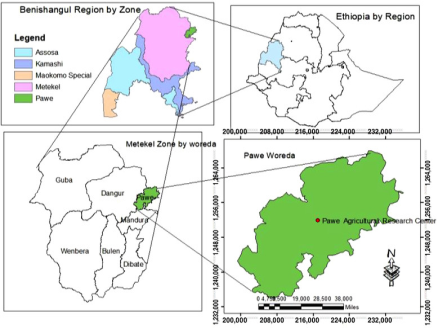
The experiment was conducted in Pawe district of Metekel zone in the northwestern part of the country (Figure 1). The area is located at 570 km away from Addis Ababa and is part of the Upper Blue Nine Basin, Ethiopia. It located 11°17’46’’ - 11°20’0’’ North latitude and 36°27’22’’ - 36°28’20’’ East longitude with an elevation range of 1071-1158 meters above sea level (m.a.s.l). The area is characterized by gently undulating to undulating plain with an average slope of 5% .
Figure 1. Location map of the study area.
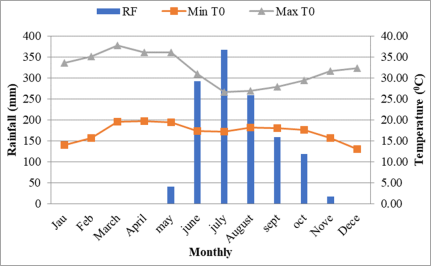
The study area has a unimodal rainfall pattern with a peak rainy season is from June to August (Figure 2). According to the meteorological records of 2022, the annual rainfall is 1254 mm. It is characterized as a warm sub-humid and moist lowland area with very high rainfall. The mean annual maximum and minimum temperatures are 37.7°C and 13.1°C, respectively. The coldest months are December and January, whereas February to May is hottest.
Figure 2. Monthly rainfall (mm), minimum and maximum temperature of the study area.
2.2. Experimental Design and Source of Materials
The experiment was laid out in a randomized complete block design (RCBD) with five replications (farmer’s as a replication). It consisted of four treatments: unfertilized and un-inoculated control (negative control), NPS fertilizer at a rate of 100 kg ha-1, NEM isolate, and Dibate-modermo isolate. Dibate-modermo isolate was first identified by Holeta Agricultural Research Center (HARC) from groundnut root nodules around the Metekel zone, while NEM is a promising exotic isolate included for comparison in the study. Lignite-based inoculants of each isolate were prepared at HARC microbial laboratory and applied at a rate of 10 g per kg of seed, which was moistened with 10% sucrose . Seeds were allowed to air dry under shade for a few minutes and were then sown at the rate of 70 kg per ha. Un-inoculated plots were planted first, followed by inoculated treatments to avoid cross-contamination. An improved groundnut (Arachis hypogaea L.) variety Maniputer was used as a test crop.
2.3. Field Management
The experimental field was prepared by a pair of oxen following the conventional tillage practice (three times tillage before planting), then leveled for plot preparation. During field layout, space between plots and blocks was separated by paths of 1 m and 2 m, respectively. The crop was planted in rows with recommended inter- and intra-row spacing of 60 cm and 10 cm, respectively. All recommended agronomic practices were timely applied in the course of the experiment.
2.4. Soil Sampling and Analysis
A composite soil sample (0-20 cm depth) was collected diagonally before treatment application (five composite soil samples) to evaluate the nutrient status of the study area. Each composite soil sample was analysed for soil pH, organic carbon, total nitrogen, available phosphorous contents, and soil texture. The soil samples were properly labeled with the appropriate information, and transported to the soil laboratory. Soil samples were air-dried, ground using mortar and pestle, and crushed to pass through a 2 mm diameter sieve for analysis. The samples were passed through a 0.5 mm sieve for determination of organic carbon and total nitrogen contents. Soil pH was determined by potentiometric method at a 1:2.5 soil-to-water ratio as described by . Soil organic carbon content was determined by the Walkley-Black oxidation method . Total nitrogen (TN) was determined by the Kjeldahl digestion method . Available phosphorous was determined by the Bray II methods . The analysis was carried out in the Soil and Water Laboratory Analysis at Pawe Agricultural Research Center (PARC).
2.5. Agronomic Data Collection
All agronomic data, such as nodule number, plant height, and number of branches, pods and seeds per plant, number of pods without seed, haulm weight and grain yield, were collected at the recommended time. All plant growth and yield-related traits were recorded for ten (10) randomly sampled plants from the harvestable rows in each plot. The haulm yield of each net plot was harvested close to the ground surface with sharp sickles and sun-dried in open air to attain a constant weight, and recorded by weighting using a sensitive balance. The grain yield of each net plot was estimated by adjusting moisture content to 12.5% and converted to a hectare basis using the following formula.
Adjusted grain yield=100-actual grain moisture content100-12.5%*grain yield
2.6. Statistical Analysis
All agronomic data were subjected to analysis of variance (ANOVA), as outlined for randomized completed block design (RCBD), using the General Linear Model (GLM) of the statistical analysis software version 9.4. Whenever the ANOVA detected significant differences between treatments, mean separation was conducted using the least significant difference (LSD) test at P<0.05.
2.7. Partial Budget Analysis
Economic analysis was done to investigate the economic feasibility of the treatments. The partial budget analysis was carried out based on the formula developed by
Variable costs, gross field benefit, adjusted yield, net benefit and marginal rate of return were calculated for each treatment. The prices of inorganic fertilizer, bio-fertilizer, grain and haulm yields and labor costs were estimated based on the current market condition in the area at the time of harvesting.
Adjusted yield (AjY): the average yield was adjusted downward by 10% to reflect the difference between the experimental yield and the yield of farmers. AjY = AvY- (AvY x 0.1).
Net financial benefit (NFB): was calculated by subtracting the total costs that vary from gross field benefits for each treatment. NFB = GFB – TVC.
Marginal rate of return (MRR%): was calculated by dividing the change in net benefit by a change in total variable cost.
MRR (%)=Change in NFB Change in TVC*100%
3. Results and Discussion
3.1. Soil Physico-Chemical Properties Before Treatment Application
Soil physicochemical properties of the experimental site before treatment application are summarized and presented in (Table 1). The laboratory result indicated that the soil has clay texture and its soil pH ranges from extremely to very strongly acidic soils condition . Available phosphorous content of the soil is in a very low range . Its total nitrogen and organic carbon contents are classified as low . In general, physicochemical properties of the soil are in low range due to continuous removal of essential plant nutrients by high runoff.
Table 1. Soil physico-chemical properties before treatment application.

Replication

pH (1:2.5 H2O)

Available Phosphorous (mg kg-1)

Organic Carbon (%)

Total N (%)

Texture (%)

Clay (%)

Silt (%)

Sand (%)

Textural Class

1

4.9

2.66

2.55

0.17

52

6

42

Clay

2

4.39

2.24

2.25

0.21

50

10

40

Clay

3

4.48

2.78

2.60

0.21

46

12

42

Clay

4

4.46

2.63

2.50

0.19

50

12

38

Clay

5

4.66

2.24

2.53

0.25

44

16

40

Clay

Mean

4.58

2.51

2.49

0.21

48.4

11.2

40.4

Clay

3.2. Yield and Yield Components of Groundnut
Results of the study showed that plant height, number of nodules, branches, pods, seeds per plant, haulm yield and grain yield were significantly affected by the treatments, but number of pods without seeds and pegs without pods don’t show a significant difference among treatments (Table 2).
The highest number of nodules per plant (121.9) was recorded for plot treated with Dibate-modermo isolate, while the lowest (64.8) was recorded for the untreated control plot. As a result, inoculation of groundnut seeds with Dibate-modermo isolate increased the number of nodules per plant by 88.1% as compared to the untreated control. The presence of nodules in the uninoculated plots confirms the presence of indigenous rhizobia that can nodulated groundnut in the area. Groundnut has been previously considered to be a highly promiscuous species, nodulated by rhizobia from a diverse group of legumes and a large group of unrelated rhizobia . In the present study, variations in between the inoculated and uninoculated plots for number of nodules per plant could be attributed to the effectiveness of introduced isolates. The number of nodules per plant recorded in the present study was higher than that reported in some previous studies with exotic isolates and for soybean inoculation with two exotic and one local isolates .
Both inoculation and application of inorganic fertilizer (NPS) enhanced the growth of groundnut as evidenced by the improvement in plant height of the crop. The tallest plant (39.42 cm) was recorded for plots that received the inorganic fertilizer, which was statistically comparable with those inoculated with Dibate-modermo and NEM isolates. However, the shortest plant (32.26 cm) was recorded for the control plot. The increase in plant height could be attributed to the pronounced vegetative growth of groundnut due to increased nitrogen supply from biological nitrogen fixation by inoculants as well as sourced from inorganic fertilizer NPS.
The analysis of variance showed that treatments had highly significant (P < 0.01) effect on the number of branches per plant (NBPP). The highest number of branches per plant (7.4) was recorded for application of Dibate-modermo isolate, but it was statistically comparable with those plots treated with NEM isolate and the chemical fertilizer. Whereas, the smallest number of branches per plant (5.68) was recorded for the control plot. Number of seeds per plant (NSPP) was also significantly affected by application of different treatments. The highest number of seeds per plant (23.9) was recorded for application of Dibate-modermo isolate. Conversely, the lowest value (16.24) was recorded for the control plot. The number of seeds per plant increased by 47.2% due to inoculation of groundnut by Dibate-modermo isolate as compared to the untreated control plot.
The number of pods per plant (NPPP) showed similar trend as did number of pod per plant. Seed inoculation with Dibate-modermo isolate resulted in the highest number of pods per plant (15.6). But, it was statistically at par with application of chemical fertilizer and plots treated with NEM isolate, which exhibited 14.1 and 13.9 pods per plant, respectively. On the other hand, the lowest number of pods per plant (11.06) was recorded for the control plot. The increase in number of pods per plant due to inoculation of Dibate-modermo isolate was 41% when compared with the control plot. This could be due to increases in the supply of nitrogen from nitrogen fixation, which increased plant vigor and the number of pod bearing branches. The increase in the number of pods per plant due to inoculation of groundnut by Dibate-modermo isolate in this study was higher than the 21.4% increase reported by .
The effect of inoculation showed significant variation among treatments for haulm yield (kg ha-1). The highest haulm yield (3680 kg ha-1) was obtained from plots that were inoculated with Dibate-modermo isolate, but it didn’t show statistically significant difference from those plots treated with NEM isolate and chemical fertilizer. Conversely, the lowest haulm yield (2153kg ha-1) was recorded for the control (no input) plot. As a result, seed inoculation with Dibate-modermo isolate increased haulm yield by 70.9% over the control plot. Increase in haulm yield due to inoculation of effective rhizobium isolates could be attributed to improved vegetative growth of plant parts, such as increases in leaf area index, due to improved soil physicochemical properties and increased nitrogen supply to the plants.
The analysis of variance showed a significant difference (P<0.01) among treatments for grain yield of groundnut. The highest grain yield (887.7 kg ha-1) was obtained from plots that were inoculated with Dibate-modermo isolate, but it was statistically at par with those plots inoculated with NEM isolate and treated with NPS fertilizer. Conversely, the lowest grain yield (592.3 kg ha-1) was recorded for the untreated plot. Seed inoculation with Dibate-modermo isolate increased grain yield by 49.9% over the untreated control plot. The effect of inoculation with indigenous rhizobial isolates in enhancing nodulation of groundnut and improving the number of seeds per plant and grain yield has been previously reported by . Similar results obtained from legume fix, a rhizobia inoculant that helps to increase natural population of beneficial nitrogen-fixing bacteria to form effective nodules that are responsible for effective biological nitrogen fixation (BNF) and yield increase as compared to uninoculated .
Table 2. Effects of nitrogen-fixing inoculants on yield and yield components of groundnut in Pawe district.

Treatment

NN

PH (cm)

NBPP

NPPP

NSPP

PDWOS

PG WOP

HY (kg ha-1)

GY (kg ha-1)

Negative control

64.8b

32.26b

5.68b

11.06b

16.24c

4.28

2.62

2153.3b

592.3c

NPS 100 kg ha-1

65.24b

39.42a

7.04a

14.1a

20.9ab

4.36

2.82

3333.3a

823.5ab

NEM isolate

65.84b

38.02a

7.2a

13.9a

19.56bc

5.14

3.52

3160a

691.8bc

Dibate modermo isolate

121.9a

38.62a

7.4a

15.6a

23.9a

3.88

2.9

3680a

887.7a

CV (%)

18.8

8.13

10.46

12

14.6

24.1

23.7

19.6

15.5

LSD (%)

20.6

4.15

0.98

2.26

4.05

1.28

0.96

833.2

160.14

**

Significant level

***

**

**

**

**

Ns

Ns

**

Means followed by the same letter(s) with in a column are non-significantly different at p<0.05. *** Significant at P < 0.001, ** significant at P < 0.01, * significant at P < 0.05, ns – non-significant difference. NN= Nodule number, PH= Plant height, NBPP= Number of branch per plant, NPPP= Number of pod per plant, NSPP= Number of seed per plant, PD WOS= number of Pods without seed, PG WOP= Pegs without pod, HY = haulm yield, GY= Grain yield.
3.3. Partial Budget Analysis
The prices of groundnut at the local market during harvesting time (80 ETB kg-1), bio-fertilizer (55 ETB per sachet), haulm yield (4.70 ETB per kg), and the official price of NPS fertilizer (38 ETB per kg) were used for partial budget analysis. Results of the partial budget analyses revealed a maximum net benefit of 75,460.8 ETB ha-1 with an acceptable MRR (2667.7%) due to inoculation with Dibate-modermo isolate. The treatment produced 23,706.7ETB ha-1 more than control. The next maximum net benefit of 69,591.9ETB ha-1 with an acceptable MRR of 469.42% was recorded for the treatment that received 100 kg ha-1 NPS fertilizer. According to , treatment recommendation is not necessarily based on the highest marginal rate of return, but rather based on the lowest cost, the highest net benefit, and the highest grain yield. Hence, applications of Dibate-modermo isolate were found to be the best economically feasible option for groundnut production in the study area, which provided the net benefit of (75,460.8 ETB ha-1) with acceptable MRR (2667.7%). This finding also suggests that, in the absence of Dibate-modermo isolate, application of 100 kg NPS ha-1 has a good economic return in the research area and other places with similar agro-ecology.
Table 3. Economic analysis for the effect of nitrogen-fixing inoculants on groundnut production in Pawe district.

Trt

Treatments

GY

AGY

HY

AHY

GFBGY

GFBHY

TGB

TVC

TNB

MRR (%)

1

Negative control

592.3

533.07

2153.3

1937.97

42645.6

9108.46

51754

0

51,754.1

-

2

NPS 100 kg ha-1

823.5

741.15

3333.3

2999.97

59292

14099.86

73392

3800

69,591.9

469.42

4

Dibate-Modermo isolate

887.7

798.93

3680

3312

63914.4

15566.4

79481

4020

75,460.8

2667.7

3

NEM isolate

691.8

622.62

3160

2844

49809.6

13366.8

63176

4020

59,156.4

D

GY= Grain yield, HY= Haulm yield, AGY=Adjusted grain yield, AHY=Adjusted haulm yield, GFBGY=Gross field benefit grain yield, GFBHY= Gross field benefit haulm yield, TGB=Total gross benefit, TVC=Total variable cost, TNB=Total net benefit, MRR=marginal rate of return, D = dominated.
4. Conclusion and Recommendation
The soils of the experimental sites are strongly acidic, deficient in available phosphorous, organic carbon, and total nitrogen, justifying the need for application soil fertility management practices to boost crop yield. Hence, application of nitrogen-fixing rhizobial inoculants has a significant role in the improvement of soil fertility and crop productivity. In line with this, results of the present study showed that seed inoculation with Dibate-modermo isolate significantly improved most agronomic parameters of the crop. Economically, application of Dibate-modermo isolate was found to be the best option, as it resulted in the maximum net benefit with an acceptable marginal rate of return (MRR). Hence, it is concluded that Dibate-modermo isolate should be mass produced and distributed to farmers for enhanced groundnut production in Pawe district.
Abbreviations

CIMMYT

International Maize and Wheat Improvement Center

TSP

Triple Super Phosphate

MRR

Marginal Rate of Return

BNF

Biological Nitrogen Fixation

Acknowledgments
The authors are grateful to the farmers for allowing the experiment to be carried out on their farm plots and for their valuable support during the study period. We would like to thanks to the Ethiopian Institute of Agricultural Research in Pawe Agricultural Research Center for their support in facilitating all the necessary materials during study period.
Author Contributions
Asresach Addisu: Conceptualization, Proposal writing, Data collection, Investigation, Methodology, Software analysis, Validation, Visualization, Writing – original draft, Writing – review & editing
Mesfin Kuma: Conceptualization, Investigation, Methodology, Supervision, Validation, Visualization, Writing-review & editing
Wubayehu Kidanemariam: Investigation, Methodology, Supervision, Validation, writing review & editing
Misganew Andualem: Investigation, Methodology, Supervision, review & editing
Seble Getaneh: Investigation, Methodology, Supervision, review & editing
Conflicts of Interest
The authors declare no conflicts of interest.
References
[1] Alwi N., Wynne J. C., Rawlings J. O., Schneeweis T. J. and Elkan G. E. 1989. Symbiotic relationship between Bradyrhizobium strains and peanut. Crop Sci 29: 50–54.
[2] Anteneh Argaw. 2014. Response of soybean to inoculation with Brady rhizobium spp. in saline soils of Shinille plains, Eastern Ethiopia. East African Journal of Sciences 8(2): 79–90.
[3] Asfaw Hailemariam and Angaw Tsige. 2006. Biological Nitrogen Fixation (BNF) Research on Food Legumes in Ethiopia. In: Workshop on Food and Forage Legumes of Ethiopia, p172-176, (Kemal Ali, Seid Ahmed, SurendraBeniwal, Gemechu Kenneni, Rajendra S. Malhotra and Khaled Makkoukeds). ICARDA, Aleppo, Syria.
[4] Bray H. R. and Kurtz L. T. 1945. Determination of organic and available forms of phosphorus in soils. Soil Science. 9: 39-46.
[5] Carter M. 1993. Soil sampling and methods of analysis. Canadian Soil Science Society. Boca Raton, Florid: Lewis Publishers, 823pp.
[6] Chen H, Richardson AE, Rolfe B. G. 2008. Studies on the physiological and genetic basis of acid tolerance in Rhizobium leguminosarum biovar trifolii. Appl Environ Microbial 59: 1798–1804.
[7] CIMMYT. 1988. From Agronomic Data to Farmer Recommendations: An Economics Training Manual. Completely Revised Edition. Mexico.
[8] CSA. 2009. Agricultural sample survey 2008/2009 Result of area and production for 2007/2008 and 2008/2009 Meher season, Statistical Bull, Addis Ababa.
[9] Deaker R., Roughly R. J. and Kennedy I. R. 2004. Legume seed inoculation technology a review. Soil Biol Biochem 36: 1275–1288.
[10] Dejene Abera, Liben F. M., Tesfaye Shimbir, Tesfaye Balemi, Teklu Erkossa, Mulugeta Demiss, and Lulseged Tamene. 2020. Guideline for agronomy and soil fertility data collection in Ethiopia: National Standard. Ethiopian Institute of Agricultural Research (EIAR). Addis Ababa, Ethiopia. p1-31.
[11] Desta Beyene and Angaw Tsige. 1986. The response of pulse crops to N and P fertilizers. In: Soil Science Research. Proceedings of the first Soil Science Research Review Workshop, Addis Ababa, Ethiopia, 11-14.
[12] EARO. 2000. Lowland pulses research strategy. Addis Ababa, Ethiopia, pp1-39.
[13] Hazelton P. and Murphy B. 2007. Interpreting Soil Test Results: What do all those Numbers Mean? CSIRO. Department of Natural Resources. 169pp.
[14] Jaiswal SK., Semira MB. and Dakora FD. 2016. Distribution, diversity, and population composition of soybean-nodulating Brady rhizobia from different agro-climatic regions in Ethiopia. Biology and Fertility of Soils 52(5): 725–738.
[15] Landon JR. 1991. Booker Tropical Soil manual: A handbook for Soil Survey and Agricultural Land Evaluation in the Tropics and Subtropics. Longman Scientific and Technical, Essex, New York, 474p.
[16] Lindström K., Murwira M., Willems A. and Altier N. 2010. The biodiversity of beneficial microbe–host mutualism: the case of rhizobia. Res Microbiology 161: 453–463.
[17] Mampos-Mondragon MG, Calderon AM, Dela Barca A, Duran-Prado, Campos-Reyes LC, Oliart-Ros RM, Ortega-Garcia J, Medina-Juarez LA, and Angulo O. 2009. Nutritional composition of new peanut cultivars, Grasos Y. Aceites, 60: 161-167.
[18] Massawe PI., Mtei KM., Munishi LK. and Ndakidemi PA. 2016. Effect of Rhizobium and Intercropping Systems on Soil Nutrients and Biological Nitrogen Fixation as Influenced by Legumes (Phaseolus vulgaris and Dolichos lablab). International Journal of Current Microbiology and Applied Sciences 5(10): 135-149.
[19] Mesfin Kuma, Mamo Bekele, Wubayehu G/M. and Getachew Yilma. 2020. Evaluation of elites isolates of Brady rhizobia nodulating groundnut (A. hypogea L.) on major growing parts in Metekel Zone, northern western Ethiopia. International Journal of Advanced Research in Biological Sciences, Vol 7(5).
[20] Rowell DL. 1994. Soil science: Methods & Applications. Addison Wesley Longman Singapore Publishers P. Ltd., England, UK. 350p.
[21] Rice W. A., Olsen P. E., Lupwayi N. Z., and Clayton G. W. 2001. Field comparison of pre-inoculated alfalfa seeds and traditional seed inoculation with inoculant prepared in sterile or non-sterile peat. Commun. Soil Sci. Plant Anal., 32, 2091-2107.
[22] Sahlemedhin Serstu and Taye Bekele. 2000. Procedures for Soil and Plant Analysis. National Soil testing center Addis Ababa, Ethiopia.
[23] SAS (Statistical Analysis System). 2014. Applied Statistics and SAS Programming Language, 4th ed. Cary, NC: SAS Institute.
[24] Savage G. P. and Keenan J. I. 1996. The composition and nutritive value of groundnut kernels. In: J. Smart (Editor), the Groundnut Crop: A Scientific Basis for Improvement. Chapman and Hall, London, pp173-213.
[25] Tamiru Solomon, Lalit Mohan Pant and Tsige Angaw. 2012. Effects of inoculation by Brady rhizobium japonicum strains on nodulation, nitrogen fixation, and yield of soybean (Glycine max L. Merill) varieties on Nitisols of Bako, Western Ethiopia. ISRN Agronomy 2012: 261475.
[26] Walkley A. and Black C. A. 1934. An examination of the Degtjareff method for determining soil organic matter and proposed modification of the chromic acid titration method. Soil Science. 37: 29-38.
[27] Weiss EA. 1983. Oilseed crops, Longman, London and New York.
[28] Wolde Selassie Abbute. 1998. The forest resources of Ethiopia: Past and Present. Walia, 19: 10-28.
[29] Yifru Abera, Cargele Masso & Fassil Assefa. 2019. Inoculation with indigenous rhizobial isolates enhanced nodulation, growth, yield, and protein content of soybean (Glycine max L.) at different agro-climatic regions in Ethiopia. Journal of plant nutrition V (42): 16.
Cite This Article
  • APA Style

    Addisu, A., Kuma, M., Kidanemariam, W., Andualem, M., Getaneh, S. (2025). Evaluation of Nitrogen-fixing Inoculants for Enhanced Production of Groundnut (Arachis hypogea L.) in Pawe District, North Western Ethiopia. Biochemistry and Molecular Biology, 10(1), 1-8. https://doi.org/10.11648/j.bmb.20251001.11

    Copy | Download

    ACS Style

    Addisu, A.; Kuma, M.; Kidanemariam, W.; Andualem, M.; Getaneh, S. Evaluation of Nitrogen-fixing Inoculants for Enhanced Production of Groundnut (Arachis hypogea L.) in Pawe District, North Western Ethiopia. Biochem. Mol. Biol. 2025, 10(1), 1-8. doi: 10.11648/j.bmb.20251001.11

    Copy | Download

    AMA Style

    Addisu A, Kuma M, Kidanemariam W, Andualem M, Getaneh S. Evaluation of Nitrogen-fixing Inoculants for Enhanced Production of Groundnut (Arachis hypogea L.) in Pawe District, North Western Ethiopia. Biochem Mol Biol. 2025;10(1):1-8. doi: 10.11648/j.bmb.20251001.11

    Copy | Download

  • @article{10.11648/j.bmb.20251001.11,
      author = {Asresach Addisu and Mesfin Kuma and Wubayehu Kidanemariam and Misganew Andualem and Seble Getaneh},
      title = {Evaluation of Nitrogen-fixing Inoculants for Enhanced Production of Groundnut (Arachis hypogea L.) in Pawe District, North Western Ethiopia
    },
      journal = {Biochemistry and Molecular Biology},
      volume = {10},
      number = {1},
      pages = {1-8},
      doi = {10.11648/j.bmb.20251001.11},
      url = {https://doi.org/10.11648/j.bmb.20251001.11},
      eprint = {https://article.sciencepublishinggroup.com/pdf/10.11648.j.bmb.20251001.11},
      abstract = {Groundnut (Arachis hypogea L.) cultivation in Ethiopia is dominated by smallholder farmers who use little or no inputs, often resulting in low yields. The use of effective rhizobia isolates was considered an ecologically and environmentally sound approach for groundnut production. A field experiment was conducted in the Pawe district in Metekel zone, Benishangul Gumuz National Regional State (BGNRS) during the 2022 cropping season on five farmers’ field to evaluate the effectiveness of nitrogen-fixing inoculants of groundnut, namely, Dibate-modermo. The experiment consisted of four treatments; T1=negative control (without chemical fertilizer and inoculant), T2= NPS fertilizer at a rate of 100kg ha-1, T3=NEM isolate, and T4=Dibate-modermo isolate. It was laid out in a randomized complete block design with five replications. Five composite soil samples were collected from 0-20 cm depth before planting and analyzed for selected soil properties. The treatments were not replicated per farm; instead, farmers were used as a replicates. Results of the analysis of variance (ANOVA) indicated that plant height, number of nodules, branches, seeds, and pods per plant, haulm yield, and grain yield were significantly affected by the application of treatments. The highest grain yield was obtained with inoculation of Dibate-modermo isolate, which increased grain yield by 49.9% as compared to the untreated plots. Similarly, this isolate resulted in the highest net benefit (75,460.8ETB ha-1) with acceptable MRR (2667.7%). Hence, mass production and utilization of Dibate-modermo isolate is recommended for enhanced production and improved productivity of groundnut in the area.
    },
     year = {2025}
    }
    

    Copy | Download

  • TY  - JOUR
    T1  - Evaluation of Nitrogen-fixing Inoculants for Enhanced Production of Groundnut (Arachis hypogea L.) in Pawe District, North Western Ethiopia
    
    AU  - Asresach Addisu
    AU  - Mesfin Kuma
    AU  - Wubayehu Kidanemariam
    AU  - Misganew Andualem
    AU  - Seble Getaneh
    Y1  - 2025/04/29
    PY  - 2025
    N1  - https://doi.org/10.11648/j.bmb.20251001.11
    DO  - 10.11648/j.bmb.20251001.11
    T2  - Biochemistry and Molecular Biology
    JF  - Biochemistry and Molecular Biology
    JO  - Biochemistry and Molecular Biology
    SP  - 1
    EP  - 8
    PB  - Science Publishing Group
    SN  - 2575-5048
    UR  - https://doi.org/10.11648/j.bmb.20251001.11
    AB  - Groundnut (Arachis hypogea L.) cultivation in Ethiopia is dominated by smallholder farmers who use little or no inputs, often resulting in low yields. The use of effective rhizobia isolates was considered an ecologically and environmentally sound approach for groundnut production. A field experiment was conducted in the Pawe district in Metekel zone, Benishangul Gumuz National Regional State (BGNRS) during the 2022 cropping season on five farmers’ field to evaluate the effectiveness of nitrogen-fixing inoculants of groundnut, namely, Dibate-modermo. The experiment consisted of four treatments; T1=negative control (without chemical fertilizer and inoculant), T2= NPS fertilizer at a rate of 100kg ha-1, T3=NEM isolate, and T4=Dibate-modermo isolate. It was laid out in a randomized complete block design with five replications. Five composite soil samples were collected from 0-20 cm depth before planting and analyzed for selected soil properties. The treatments were not replicated per farm; instead, farmers were used as a replicates. Results of the analysis of variance (ANOVA) indicated that plant height, number of nodules, branches, seeds, and pods per plant, haulm yield, and grain yield were significantly affected by the application of treatments. The highest grain yield was obtained with inoculation of Dibate-modermo isolate, which increased grain yield by 49.9% as compared to the untreated plots. Similarly, this isolate resulted in the highest net benefit (75,460.8ETB ha-1) with acceptable MRR (2667.7%). Hence, mass production and utilization of Dibate-modermo isolate is recommended for enhanced production and improved productivity of groundnut in the area.
    
    VL  - 10
    IS  - 1
    ER  - 

    Copy | Download

Author Information
  • Ethiopian Institute of Agricultural Research, Pawe Agricultural Research Center, Pawe, Ethiopia

  • Ethiopian Institute of Agricultural Research, Pawe Agricultural Research Center, Pawe, Ethiopia

  • Ethiopian Institute of Agricultural Research, Pawe Agricultural Research Center, Pawe, Ethiopia

  • Ethiopian Institute of Agricultural Research, Pawe Agricultural Research Center, Pawe, Ethiopia

  • Ethiopian Institute of Agricultural Research, Pawe Agricultural Research Center, Pawe, Ethiopia

  • Abstract
  • Keywords
  • Document Sections

    1. 1. Introduction
    2. 2. Materials and Methods
    3. 3. Results and Discussion
    4. 4. Conclusion and Recommendation
    Show Full Outline
  • Abbreviations
  • Acknowledgments
  • Author Contributions
  • Conflicts of Interest
  • References
  • Cite This Article
  • Author Information